Guernsey in this period
Guernsey is understood as a frontier island whose security matters to the Norman rulers of the Channel.

Every old family has a story about its beginning, and Anneville's is a story of the sea. A duke at Valognes. A messenger from the islanders. Pirates in a castle where the Catel church stands today. Swords on the shore, and plunder left behind. And at the end a reward: land in Guernsey for the esquire who had led the soldiers, Sampson d'Anneville.
Nobody wrote this story down at the time. It was told and retold. It was set before royal commissioners in 1597, and William Berry printed it in 1815. That does not make it worthless. A story repeated for so long shapes the way people think and act. Islanders called the fief by its d'Anneville name, and its lords were proud of the legend. In that sense the legend did real work.
Behind the legend stands a real family, and its record rests on documents. The d'Annevilles held land in the Val de Saire, the corner of Normandy that looks out towards the Channel Islands. When Duke William sailed for England in 1066, he trusted a d'Anneville to guard that coast. Thirty years later another d'Anneville left for the Holy Land with the duke's eldest son. This is the kind of family a duke called on when an island had to be freed from pirates.
About these lines: a narrative reconstruction written in the manner of C. Northcote Parkinson (1909–1993), Seigneur of the Fief d'Anneville from 1964 to 1987, historian, and author of the novels of Richard Delancey, a Guernsey sailor. Parkinson did not write them and they are not a historical source. They invent no characters and no speeches: every fact comes from the room above, and words in quotation marks are quoted from the documents cited there.
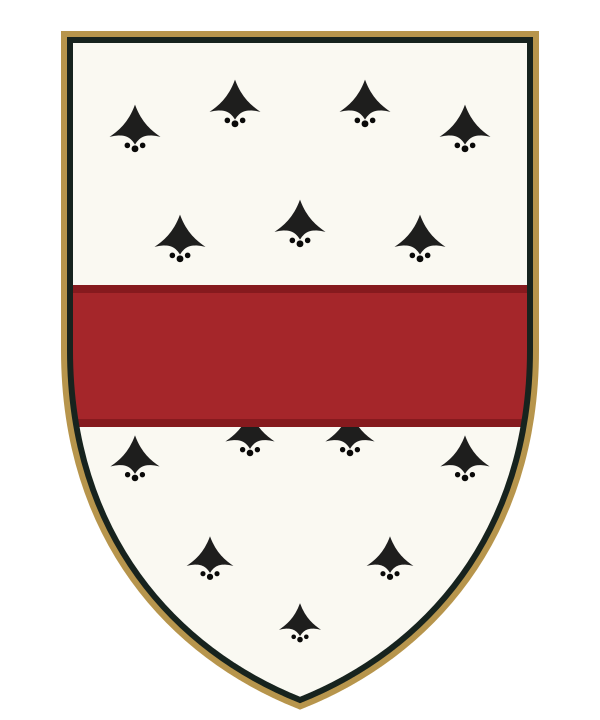 Arms associated with Anneville: ermine, a fess gules
A legend told in Guernsey makes Sampson d'Anneville the founder: the first great Norman lord of the island. William Berry wrote it down in 1815. Pirates had settled in Guernsey and built a castle near the centre of the island, "on the spot where the Catel Church now stands." The islanders sent a messenger to Duke William of Normandy, who was then at Valognes. The duke sent a troop of soldiers to help them, under the command of his esquire, Sampson d'Anneville. The pirates were killed or fled to their ships, "leaving their plunder behind them."
As a reward, the duke gave Sampson a large tract of land in the island, "by the title of the Fief and Seigneurie d'Anneville." The tradition places these events in 1061, five years before the Norman conquest of England. Legends are part of history too. This one was set before the royal commissioners who visited Guernsey in 1597, and it has stayed with the seigneurie ever since.
Whether Sampson was truly the first, we cannot know. We do know that the d'Annevilles were one of the great families of Normandy. Their history was written by the genealogist François-Alexandre Aubert de La Chesnaye des Bois (1699-1783) in his Dictionnaire de la noblesse. He calls the d'Annevilles one of the most ancient houses of Lower Normandy. Five Norman parishes bear their name. From time immemorial they held the lordship of Anneville-en-Saire, near Valognes, directly from the sovereign.
In 1066 Duke William left to conquer England. He chose a group of lords to guard Normandy for his wife, Duchess Matilda. Among them was the Seigneur d'Anneville, who received command of the Val de Saire, the north-eastern corner of the Cotentin peninsula facing the Channel Islands. Another d'Anneville, knight, crossed to England, and his children settled on the Isle of Wight.
In 1096 Michel d'Anneville, knight, left for the Holy Land on the First Crusade, with Robert Curthose, Duke of Normandy, and Godfrey of Bouillon. In 1106 his father Guillaume gave the church of Anneville-en-Saire to the Abbey of Lessay; the abbey's book, the Livre noir of Lessay, preserves the act. Geoffroy and Jean, son and grandson of Guillaume, confirmed and enlarged the gift in 1118 and 1139. Some generations later Samson d'Anneville, knight, gave the Abbey of Montebourg a yearly rent of wheat.
So the legend gives Anneville its hero, and the documents give it a family: a family trusted by the dukes, present on the First Crusade, and generous to the abbeys of the Cotentin.
Part 2 · The d'Annevilles, the Empress and the King. The d'Annevilles also took part in the politics of their time. Between 1135 and 1153 England and Normandy were torn by a civil war that historians call the Anarchy. Two cousins claimed the crown of Henry I: his daughter, the Empress Matilda, and his nephew, Stephen of Blois. Matilda's husband, Geoffrey Count of Anjou, conquered Normandy in her name in 1144. Their son became King Henry II in 1154.
The documents suggest that the d'Annevilles stood on the Empress's side. In 1139, in the middle of the war, Jean d'Anneville renewed his family's gifts to the Abbey of Lessay. De La Chesnaye records that Jean signed as a witness when Roger de Magneville sold to the Empress Matilda his lands at Octeville, near Cherbourg. Jean also gave the church of Saint-Pierre d'Arthéglise to the Abbey of Saint-Sauveur-le-Vicomte, and Henry II, the Empress's son, confirmed the gift.
These were the years in which Guernsey's fiefs took their shape. Around 1150, under Geoffrey of Anjou, the island's landholding appears to have been reorganised. Waste land became the King's own fief, the Fief Le Roi, and some military fiefs were probably created at that time. A. H. Ewen, the historian of Guernsey's fiefs, notes that these years brought many changes, and that at the end of them the old Fief du Bessin, the fief of the Vicomte of the Bessin, was found divided. Its quarter of the island became Le Comte, the "terre du Comte" of the royal inquest of 1248.
Some histories assume that Le Comte, as heir of the Vicomte's fief, kept its ancient privileges through these years. The evidence points the other way. In a war that reshaped fiefs everywhere, it would be unusual for one fief alone to come through with its rights untouched. Under Norman custom the "garde noble", the guardianship of an under-age heir and of his fief, belonged to the overlord. So whoever held the wardship of a fief stood, in practice, as its overlord. The wardship of Le Comte is reported at times in the hands of the lord of Anneville and at times in those of the Abbey of Mont-Saint-Michel, and Sir William de Cheney, lord of Anneville, had the custody of Le Comte while Baldwin de Vere was under age. Le Comte had no manor house of its own, and it is not among the fiefs that owe suit of court at the Chief Pleas today. Le Comte seems to have remained a fief in its own right, but under the authority of other fiefs.
This is our hypothesis. The d'Annevilles were close to the Empress's party during the Anarchy, and they were probably rewarded for it in Guernsey. This would explain why Anneville was regarded as the island's principal fief from the beginning, and why its lords later claimed superiority over Le Comte. It would also explain why the King gave Anneville to William de Cheney in 1248, and why the new lord soon held Le Comte as well. The Jerripedia article on the Fief d'Anneville sets out a similar reading: the family's loyalty to Geoffrey may explain why it kept its Guernsey lands under his rule.
In 1204 the main branch of the d'Annevilles stayed faithful to the King of France: on this there is no doubt, and the French king rewarded them for it (Room 04). Around 1200 Thomas d'Anneville, son of Samson, renewed his ancestors' gifts to Lessay, in an act that speaks of a "perpetual peace" and of the help of his "brothers", the monks and lay members of the abbey's fellowship. A Thomas d'Anneville who died in or before 1220 had evidently stayed faithful to Henry III, for his widow received her dower on his lands in Guernsey and Jersey. Whether the two are the same man is not proved. If they are, part of the family stayed with the English king while the main branch chose France.
W. Berry, The History of the Island of Guernsey (1815), p. 63; De La Chesnaye des Bois, Dictionnaire de la noblesse, article ANNEVILLE (Gallica); Livre noir de Lessay; A. H. Ewen, The Fiefs of the Island of Guernsey (La Société Guernesiaise, 1961), St Sampson. Dossier La Societas Loci Sancti Leodegarii de Annevilla (2025); Jerripedia, 'Fief d'Anneville'; The History of Guernsey, pp. 70-71.The legend follows the Norman order of loyalty. The islanders appeal to the Duke of Normandy; the Duke rewards his esquire with land, held of him in return for service. That is the shape of every fief in Guernsey. The appeal to the Duke has not disappeared: the Clameur de Haro, the cry "Haro! Haro! Haro! À l'aide, mon Prince, on me fait tort", is still part of Guernsey law, and tradition says that the Prince it calls on is Rollo.
Guernsey is understood as a frontier island whose security matters to the Norman rulers of the Channel.
The Samson tradition expresses the island’s defensive role and the knightly service attached to Anneville. It shows how Guernsey remembered its place in the Norman strategy of the Channel.
This is the story of how the fief of Anneville began. A fief was a piece of land together with the rights attached to it, held from a superior lord in exchange for loyalty and services. Tradition places a man named Samson d'Anneville in Guernsey around the year 1061, receiving a grant of land there. Old church records from Normandy then show the family continuing: a book called the Livre noir of Lessay records a Willelmus de Annevilla in 1106, a Gaufridus in 1108 and a Joannes in 1139. Charters from the Cotentin, a part of Normandy, also mention people called Anneville or Danevilla in the same Norman setting. Finally, the royal records of around 1204 show that Sampson d'Anneville's Guernsey revenues had become an escheat — land returning to the lord or the Crown because its holder had lost the right to it — taken from the lands of the Normans. Together, these traditions and records link one family, its land, its church connections and the great political split of Normandy.
In 1204 a political division split Normandy in two: the continental part of Normandy was separated from the Channel Islands, which stayed with the English Crown. The Channel Islands were the part of the old Duchy of Normandy that remained with the English kings, so the fiefs there were ultimately held of the King. The royal record from this time identifies the Guernsey revenues once held by Sampson d'Anneville as an escheat — land returning to the Crown because its holder had lost the right to it — taken from the lands of the Normans. This record, together with the older traditions and charters, connects the man Sampson, his Guernsey fief, and the decisive turning point of 1204.
A later royal charter says that the money owed to the King from Sampson d'Anneville's lands in Guernsey was an escheat — land and payments that had come back to the King — coming from the lands of the Normans. This document is evidence for the division linked to 1204, and it connects Sampson d'Anneville's Guernsey revenues directly with the lands of the Normans.
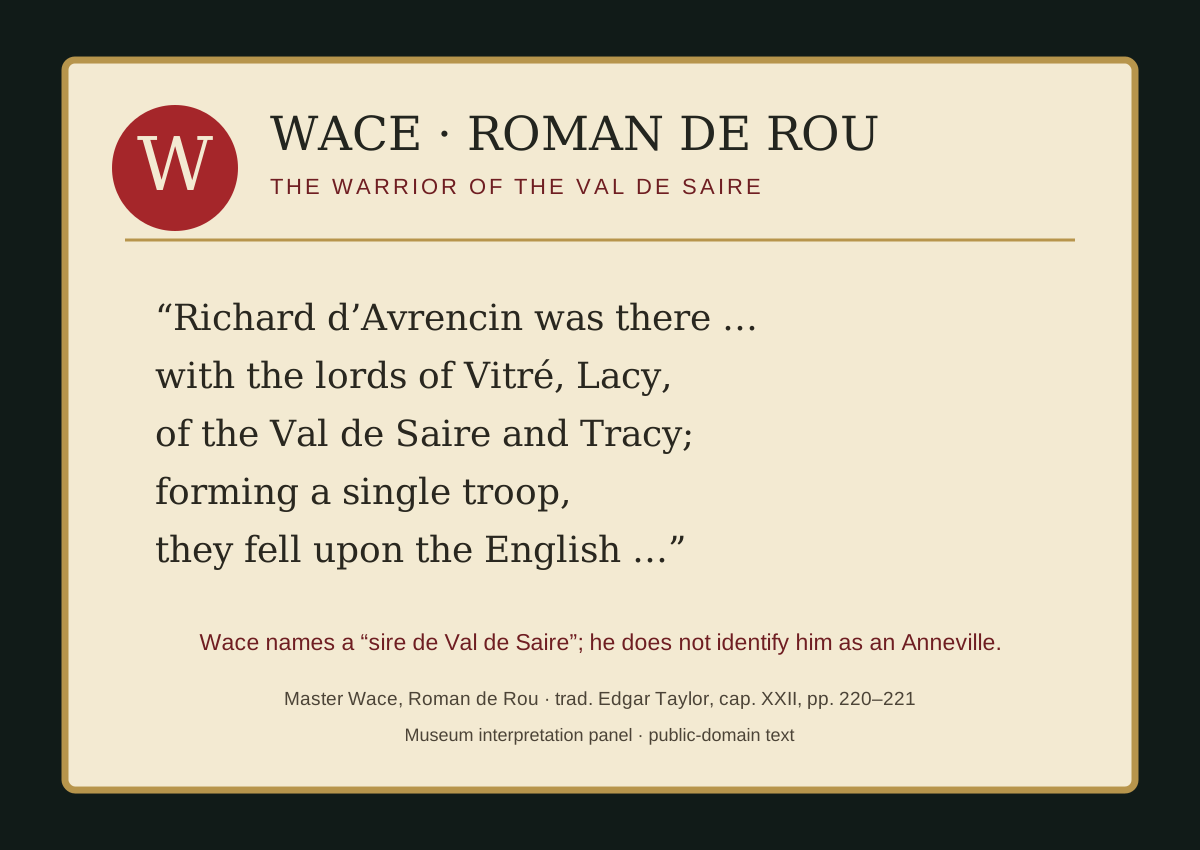
A later genealogy, citing a chronicle extract from Saint-Étienne of Caen, places the Seigneur d’Anneville among the lords entrusted with guarding Normandy in 1066 and gives him command in the Val-de-Saire. The point is not a Tudor connection—five centuries too early—but a direct place in the ducal network around William’s conquest.
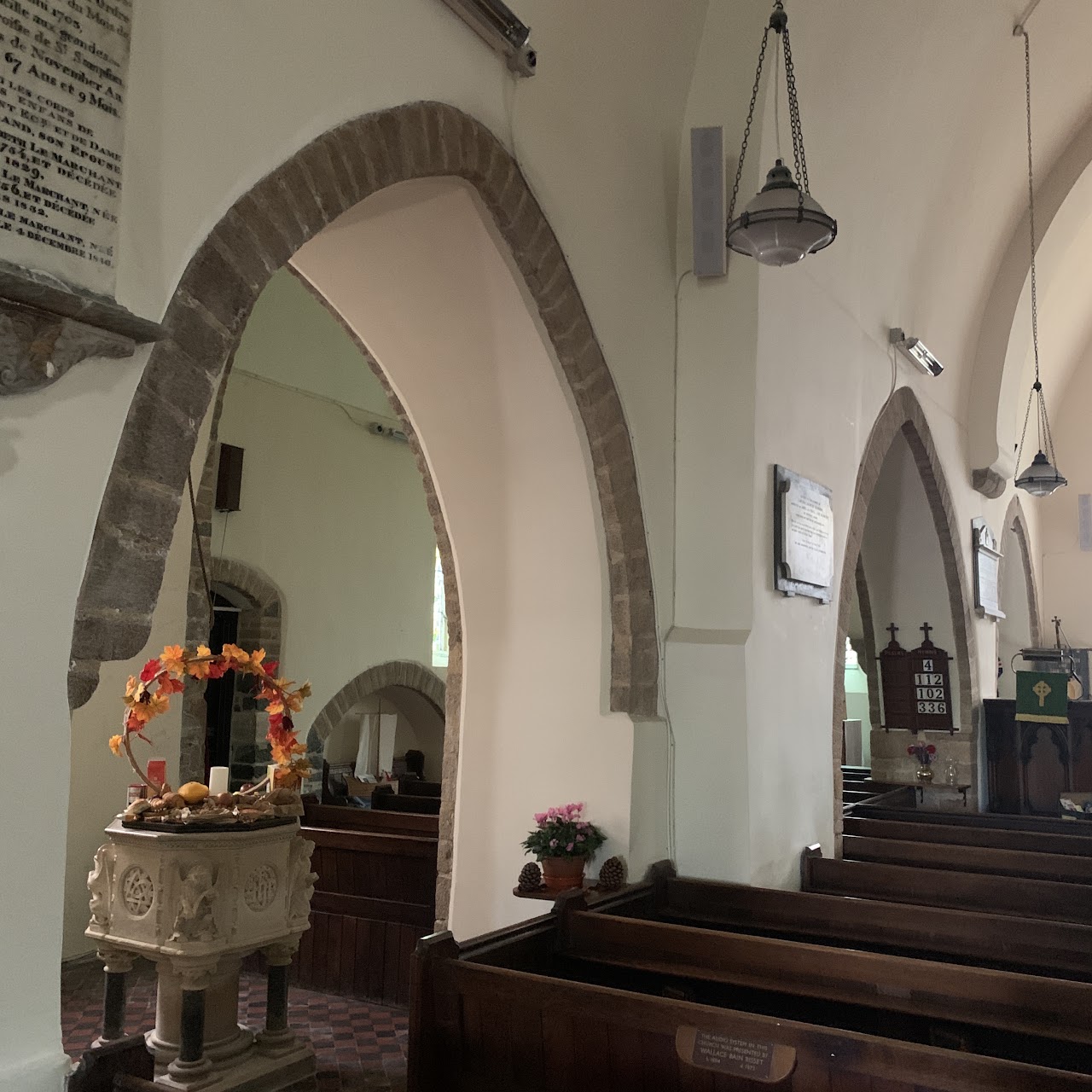 The church of Saint Sampson, which the tradition of the Seigneurie links to the son of Samson d’Anneville.Image · lordofanneville.com · Our territory in Guernsey
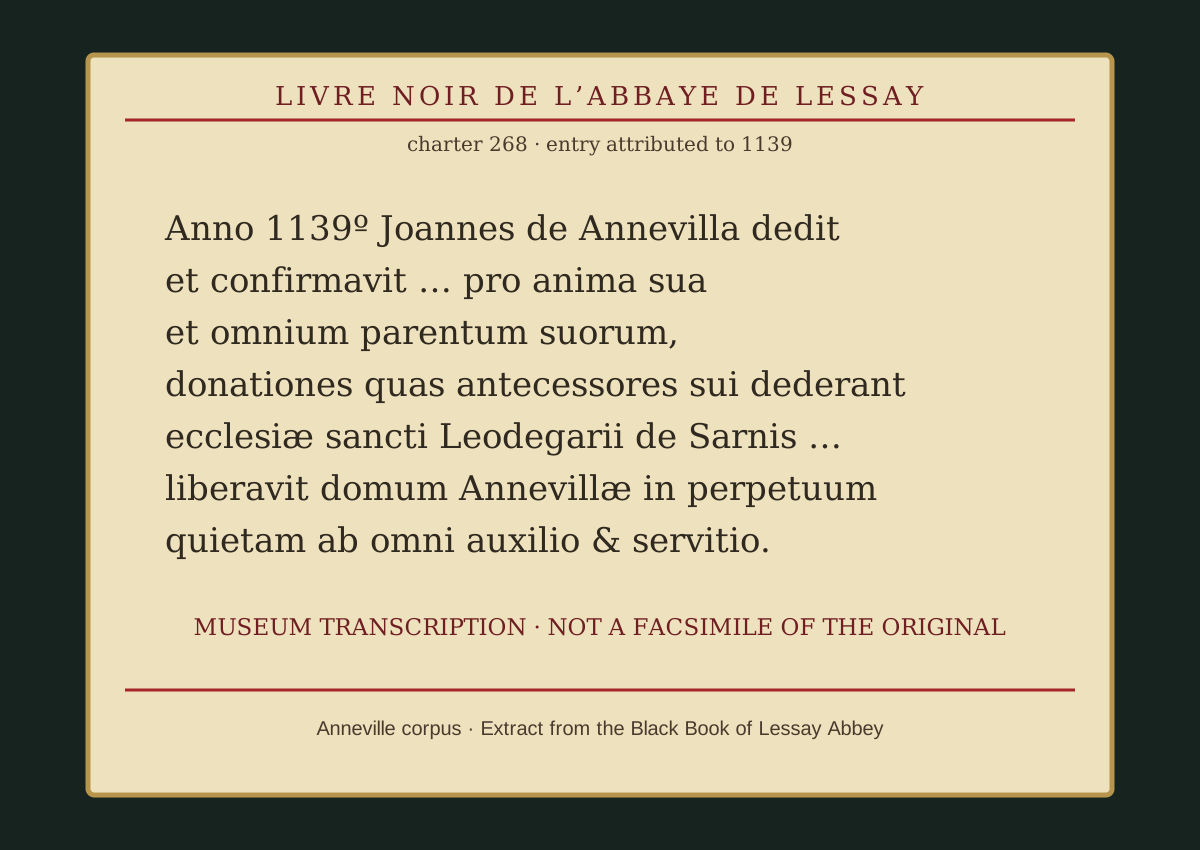 Museum transcription from the cartulary of the Abbey of Lessay.Image · Museum reconstructionMuseum panel on Wace and the Val de Saire.Image · Museum reconstructionDuke William in the Bayeux Tapestry, 1064–1066: the ducal world of Samson d’Anneville.Image · Wikimedia Commons