Guernsey in this period
Between the thirteenth and fifteenth centuries Guernsey consolidates government under the Crown through the Royal Court, Bailiffs, Wardens and local seigneurial jurisdictions.
In a small island the same few families tend to hold every office, and Guernsey in the thirteenth and fourteenth centuries followed this rule. The de Cheney first held Anneville. Then they bought Le Comte, a quarter of the island. Then they became Bailiffs, who judged the islanders, and Wardens, who governed them for the King. A family that owns the land and also runs the courts is very hard to remove, and the de Cheney stayed.
All this changed the way islanders saw the manor. When one house holds so much, people come to think of its seat as the first of all. Anneville became, in common opinion, the chief fief of Guernsey. The reasons were visible: the manor house, the fields, and the tenants who came there to pay their dues.
In 1350 the lands of Guillaume de Cheney had to be divided among his children. In the Middle Ages such a division was a legal act. It was done before a court, so that nobody could dispute it later. This court met at Anneville itself. The written record was copied two hundred years later, and the copy survives. It is one of the oldest proofs that Anneville was a living lordship, with its own court sitting in its own manor.
About these lines: a narrative reconstruction written in the manner of C. Northcote Parkinson (1909–1993), Seigneur of the Fief d'Anneville from 1964 to 1987, historian, and author of the novels of Richard Delancey, a Guernsey sailor. Parkinson did not write them and they are not a historical source. They invent no characters and no speeches: every fact comes from the room above, and words in quotation marks are quoted from the documents cited there.
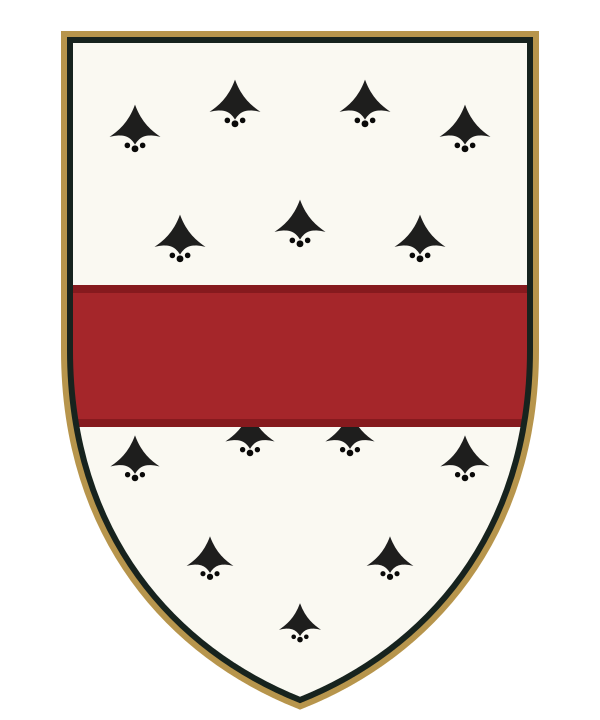 Arms associated with Anneville: ermine, a fess gules
The family that received Anneville in 1248 grew quickly in land and in power. A. H. Ewen, the historian of Guernsey's fiefs, summed it up in 1961: Sir William de Cheney "later purchased the Fief Le Comte"; the family made the Manor House of Anneville their home and bought several other fiefs in different parishes. From the second half of the thirteenth century, Anneville was the seat of the largest group of fiefs held by any lay lord in the island, that is, by anyone outside the Church.
Power followed land. The de Cheney served as Bailiffs, the chief magistrates who presided over the island's court of justice. Edmund de Cheney was Warden of the Isles by 1358, the King's governor for Guernsey and Jersey. Islanders began to speak of Anneville as the first fief of the island, the "paramount fief"; Ewen records that this idea became current.
The Crown added privileges. On 9 June 1261 the Lord Edward, eldest son of Henry III and the future Edward I, granted de Cheney free warren in Guernsey: the exclusive right to hunt small game, such as rabbits and hares, on his lands.
On 14 May 1350 the lands of Guillaume de Cheney had to be shared among his children. A court sat at the manor of Anneville itself to make the division, which was called a partage. The act tells us two things. The division was made by a court, as the law required. And Anneville was a place where justice was done: the seat of its own court. A copy of the act made in the sixteenth century survives (SG 39-02/02).
The heart of the lordship stayed in the family for more than two centuries. When the family sold them in 1509/10, the Manor of Anneville, Le Comte, Carteret and Beuval passed in a single deed (Room 07).
Charter Rolls 1248; Extente of 11 September 1248; charter of the Lord Edward, 9 June 1261; SG 39-02/02 (partage of 14 May 1350); A. H. Ewen, The Fiefs of the Island of Guernsey (1961), St Sampson; Priaulx Library, '11 September 1248'.The de Cheney made Anneville a seigneurial seat on the Norman pattern: a manor house with its own chapel, dedicated to St Thomas, a dovecote and a court. In the custom of Normandy the dovecote, the colombier, was a privilege of the fief, the sign that a house was a lord's house. The ruins of the chapel and the old doorway of the house could still be seen in the twentieth century (Rooms 06 and 15).
Between the thirteenth and fifteenth centuries Guernsey consolidates government under the Crown through the Royal Court, Bailiffs, Wardens and local seigneurial jurisdictions.
Under the de Chesney family, the seigneurial complex centred on Anneville brought together Anneville, Le Comte, Carteret and other fiefs. The partage passed at Anneville and its reversion clauses identify Anneville as the legal caput and apex of this large lay grouping. The family’s service as Bailiffs and Governors makes the room a history of Guernsey’s government, not merely a family biography.
The story of the Fief d'Anneville — a piece of land in Guernsey held from the King in return for loyalty and services — begins with two separate records from 1248. In that year a royal charter (a formal document from the King) granted William de Cheney a rente — a yearly payment owed on land — while a separate Extente, a royal survey recording what the island owed the King, recorded that this fief had a duty to keep the King's prison. In 1261 Prince Edward gave William de Cheney the right to hunt and keep small game across Guernsey. By 1299 a later holder, Philip de Cheney, said that the family's charters were kept in England. A sixteenth-century copy of a record shows that in 1350 a court was held at Anneville Manor to divide the estate of Guillaume de Cheney after his death: Edmond Chaenay received Fief le Comte, while Edmond de Cheney gained the right to live at Anneville, and these had to be dealt with as two separate things. In 1498 a chapel at St Thomas d'Anneville is recorded. In 1509/10 (the year then began on 25 March, so dates in January to March carry both years) a deed records that Robert Willoughby sold Anneville to Nicholas Fouaschin. Whether the de Chesneys of Anneville were the same family as the Cheyne line that led to Willoughby is an open question that has not been proved.
In 1261 Prince Edward granted William de Cheney free warren — the right to keep and hunt small game on his own land — throughout Guernsey. Such rights mattered both to the local economy and to a family's standing. The Garenne d'Anneville, the hunting ground attached to these rights, survives today as a nature reserve, a physical reminder of this medieval privilege granted by the Crown (the English kings, who held the Channel Islands as part of the old Duchy of Normandy).
By 1299, Philip de Cheney, a later holder of the fief, noted that the family's charters (their legal documents) were kept in England, which shows the family had a base across the Channel. In 1350 a feudal court met at the Manor House to divide the estate of Guillaume de Cheney after his death. According to a sixteenth-century copy of the record, Edmond Chaenay received Fief le Comte, a piece of land forming part of the estate, while Edmond de Cheney gained the right to live at Anneville. The court decided that these two things had to be treated as separate: the right to live at Anneville was distinct from owning the main fief itself.
In 1498 a chapel at St Thomas d'Anneville is recorded in the documents. This proves that a chapel belonging to the manor existed. It also shows one of the duties of a Seigneur, the lord of a fief: caring for the spiritual needs of the people on his land.
In 1261 Prince Edward granted a charter to Sir William de Cheney giving him free warren throughout Guernsey — that is, the right to keep and hunt small game on his land. The Garenne d'Anneville survives today as a nature reserve.
In 1299 Philip de Cheney claimed before the assizes — the island's court sessions — that he could not show the charters proving his title to the Anneville tenements, because those documents were kept in England. This shows that the family's main home was on the far side of the Channel, in England.
In 1350 a feudal court met at the Manor House of Anneville to divide up the estate of Guillaume de Cheney among his heirs. We know of this meeting through a copy made in the sixteenth century.
The record of old deeds shows that in the 1350 division of the estate Sir Edmond Chaenay received Fief le Comte — a fief, that is a piece of land together with the rights attached to it, held from a superior lord in return for loyalty and service.
The historian Carey reports that when Sir Edmond was staying in Guernsey he could use the Manor House of Anneville and the lands next to it as his residence.
In 1498 Edmond de Cheney, the lord holding the land of Fief d'Anneville, asked the Bishop of Coutances to appoint Dom John Hardy as chaplain of St Thomas d'Anneville. This request is the written proof that the manor had its own chapel, served by its own priest.
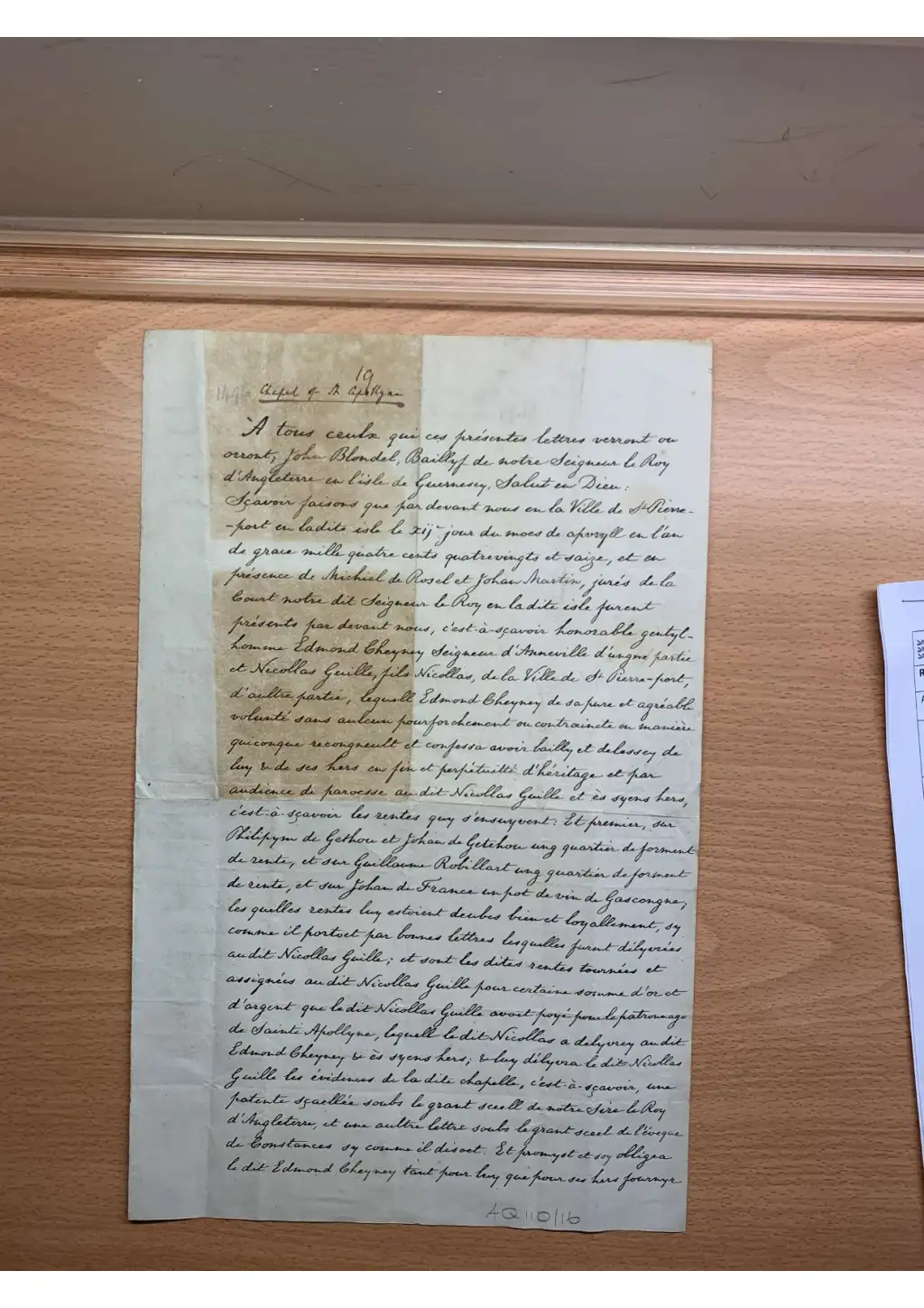
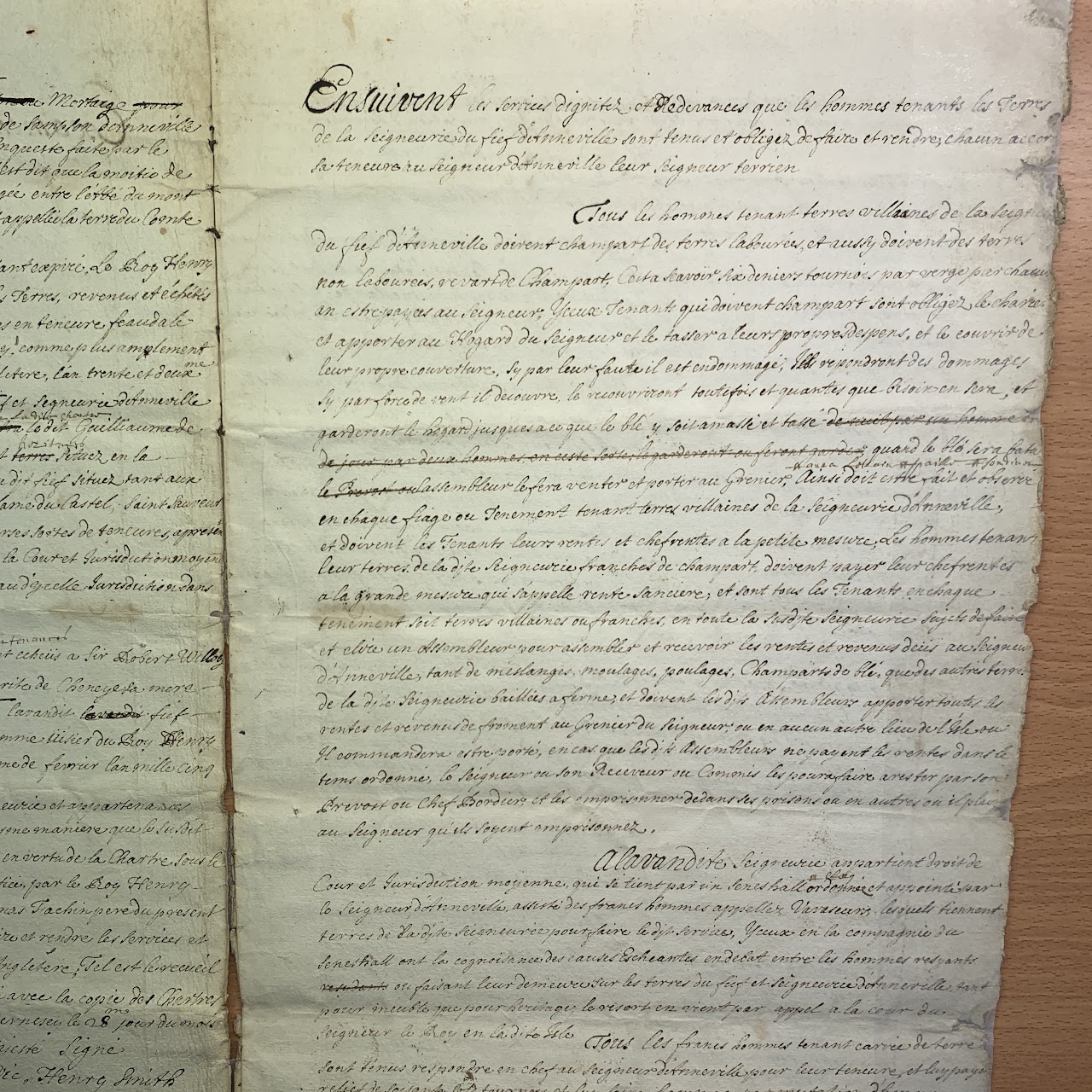
Deed of 24 April 1486 naming Edmond Chepney, Seigneur d’Anneville, before the court in St Peter Port.Image · lordofanneville.com · Feudal grants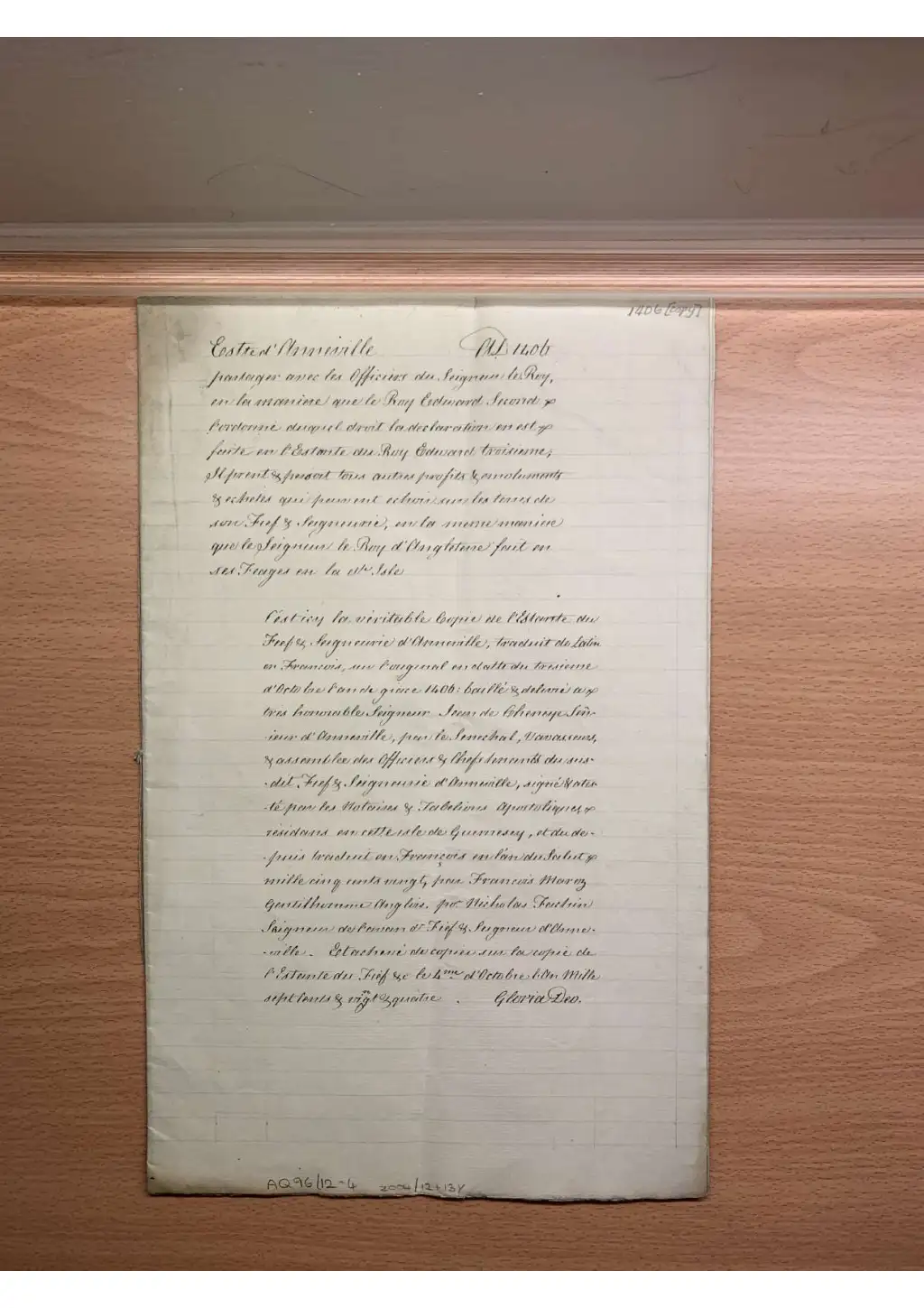 “Extentes d’Anneville”: later manuscript copy of the extent of the fief made under King Edward, with a translation of 1606 and a note dated 22 October 1794.Image · lordofanneville.com · Feudal grants